Offline
On this page

EuroPython 2026 Sprints

Join us for two days of open-source hacking, learning, and collaboration! As is tradition, the sprints will happen the weekend after EuroPython—this year on Saturday and Sunday, 18–19 July. This year joined with EuroSciPy.

The conference team provides the space, lunch, and coffee—you bring the energy, ideas, and code. Whether you're maintaining a major library or trying your first contribution, there's something for everyone.

What is a Sprint?

Sprints are informal coding sessions (think: mini hackathons) where people gather to work on open-source projects, share ideas, and solve problems together.
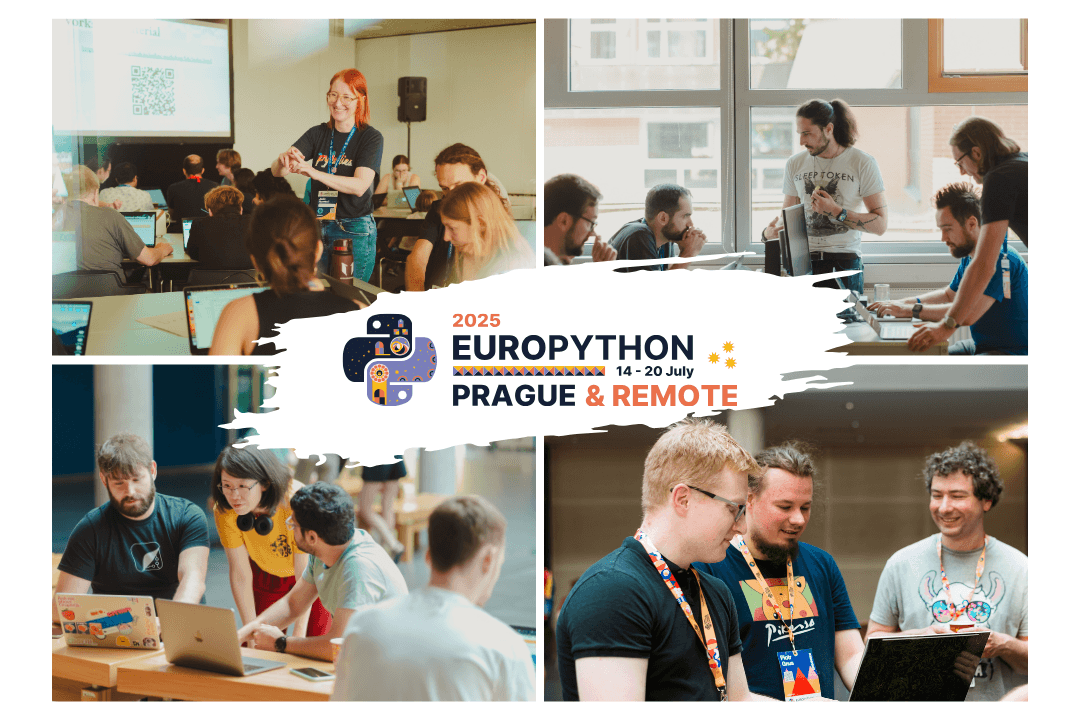
Sprints photos collage

When and Where?

The sprints will take place on Saturday and Sunday, 18–19 July, at Echo Miasta. Doors open at 9am.

Address: Kapelanka 56, 30-347 Kraków, Poland

Who Can Attend:

  • EuroPython ticket holders (Conference, Tutorial, or Combined) can join the sprints for free—just make sure to select sprint attendance when configuring your ticket.
  • No ticket? No problem. You’ll be able to register for the sprints for free—details coming soon on our tickets page.

Open-Source Projects

Anyone can submit a project for the sprints, although sprints are typically submitted by project maintainers or frequent contributors.

To submit a project for the sprints, head to the EuroPython website repository and add your project as a markdown file in the folder src/content/sprints. Use the file _sprints_template.md as the template for your project file.

💡 Quick tip: You can quickly edit and prepare your changes directly in the browser using github web-based editor.

Once your file is added, submit a Pull Request — and you're done!

19 active sprints

BeeWare

👥 10 🐍 Any
Contact: Malcolm Smith ( smith@chaquo.com ) ( @mhsmith )

Do you want to write an app for your phone or computer using nothing but Python? Have you got some Python code that you'd like to distribute to users as a standalone installer? Do you use or maintain a Python package that you'd like to build for Android or iOS?

BeeWare is a collection of libraries and tools for building a cross-platform native graphical user interface using nothing but Python, and then packaging your Python code as a standalone app for distribution on macOS, Windows, Linux, iOS, Android, or as a single-page web app. No matter your level of experience, we can find a way for you to contribute to BeeWare.

CPython Core

👥 TBA 🐍 Intermediate
Contact: Petr Viktorin ( encukou@gmail.com ) ( @encukou )

Come sprint on CPython and work on Python 3.15 and 3.16!

Sprints will focus on release candidate fixes to Python 3.15 (to be released this October), with some limited new feature work for 3.16 (final version in October 2027).

  1. Recommended for Python users with 2+ years of experience.
  2. Read what to expect (about PyCon US sprints, but a lot applies here!).
  3. Fork and clone the repository before coming to the venue in case of slow wifi :)
  4. Use the Python Developer's Guide to go through the initial build on your machine.

Django (marketing)

👥 15 🐍 Any

We need your help on Saturday to refresh Django’s marketing! We want to build a new website for the project. We’re working on a new marketing strategy to kickstart this work. We need help from newcomers bringing their fresh perspective. And seasoned Djangonauts. People who are new to marketing, or experienced. You can contribute with:

  • Feedback on Django’s current marketing and website, ideas and brainstorming on what to do differently
  • Collaborative research for specific aspects of our marketing strategy
  • Curiosity, enthusiasm, ideas, criticisms
  • Laptop or smartphone or paper and pen

Planning doc: Sprint on Django (marketing) @ EuroPython 2026

Resources that will help: Website redesign, GitLab marketing handbook, Wagtail product strategy, Drupal product strategy, WordPress marketing handbook, Marketing open source projects

If you want to chat about / work on other things than marketing, come say hi! We will focus on the one theme but would love to hear what others are up to.

Realtime dynamic pricing AI system in Python

👥 3 🐍 Intermediate

Falcon web framework

👥 ~10 🐍 Any

Falcon is a minimalist ASGI/WSGI framework for building mission-critical REST APIs and microservices, with a focus on reliability, correctness, and performance at scale.

Falcon has zero hard dependencies outside of the standard library!

This sprint is open to contributors of all experience levels — items to sprint on range from improving documentation & adding new recipes to implementing new features in the framework, including (but not limited to!):

  • Implement native OpenTelemetry support
  • Better OpenAPI story
  • Clean up stream versus binary/text media handlers
  • Built-in support for limiting request and media payload sizes
  • Adding AGENTS.md and discussing how to navigate LLM contributions

See also our contribution guide: https://falcon.readthedocs.io/community/contributing.html

Feature-engine

👥 10 🐍 Any

Modernising Feature-engine's API

Feature-engine was originally designed to bridge the gap between pandas and scikit-learn while encouraging good practices through a strict API. As the Python ecosystem has evolved, with native pandas support in scikit-learn, the emergence of Polars, and demand for more flexible workflows, Feature-engine needs to evolve while maintaining backward compatibility.

In this sprint, you'll help evolve Feature-engine's API by:

  • Adding support for Polars.
  • Extending configurable error handling across transformers, allowing users to choose between raising exceptions or continuing when appropriate.
  • Improving performance by replacing pandas operations with NumPy implementations where possible while preserving the public API.

The sprint is open to anyone interested in machine learning libraries, API design, testing, documentation, and open source development.

More details here.

GPU MODE: Cholesky Challenge

👥 20 🐍 Any
Contact: Bryce Adelstein Lelbach ( brycelelbach@gmail.com ) ( @brycelelbach ) ( @blelbach )

Come learn how to compete in a GPU MODE kernel contest by tackling the new Cholesky problem together. The challenge is to factor batches of symmetric positive-definite FP32 matrices on an NVIDIA B200. It runs through 30 July, so we can put what we learn straight onto the live leaderboard.

Every submission is a single Python file. You can begin with the working PyTorch baseline, then optimize in Python with tools such as Triton or embedded CUDA. The benchmark ranges from thousands of small matrices to one 32768-by-32768 matrix, leaving room for many different ideas. Tests and benchmarks run on hosted B200s, so you do not need a local GPU.

Bryce from NVIDIA will help participants install and register the Popcorn CLI, understand the problem, make a first correct submission, read benchmark and profiling results, and choose an optimization to try. The goal is for every newcomer to leave knowing the complete contest workflow; experienced GPU programmers are welcome to team up and chase the leaderboard.

Participants who want to use a coding agent can have Popcorn scaffold the agent's contest workflow. Bryce will show how to give an agent a concrete optimization goal, let it run the iterative edit-test-benchmark loop, inspect its performance evidence, and keep numerically incorrect changes off the leaderboard. Working directly by hand, pairing with another person, or bringing your preferred coding agent are all equally welcome.

NVIDIA will provide participants with a free sandbox VM and inference keys for the purposes of the contest.

No previous GPU-kernel or agent experience is required. Bring a laptop and a GitHub or Discord account for authentication; basic Python familiarity will help.

MicroPython & emlearn

👥 10 🐍 Any
Contact: Jon Nordby ( jononor@gmail.com ) ( @jonnor )

Interesting in using your Python skills to make physical devices, such as sensors, control systems, robots or similar? MicroPython is an implementation of Python 3 that runs on low-cost microcontrollers and has a mature ecosystem that makes programming hardware fun and productive.

In this sprint we will work on MicroPython related things, such as:

  • Making demos/examples for/using existing libraries
  • Creating new libraries for MicroPython

Open for people who have no prior experience with MicroPython! We have 5 hardware units running MicroPython that people can borrow for the sprint (Raspberry Pi Pico W RP2040).

You can also run MicroPython on your PC, as well as in the browser.

napari

👥 10 🐍 Any
Contact: Lorenzo Gaifas ( brisvag@proton.me ) ( @brisvag )

napari is a fast, interactive, multi-dimensional image viewer for Python. Check out napari.org for more information about the project, how to get started and how to contribute.

For this sprint, you'll have easy access to some members of the core team to help you get started with using, contributing or extending napari. You're welcome to join whether you never used napari or you're a long time user!

We don't have strict plans for this day, but here's a few ideas for what you could be doing:

  • ask our help with getting started with napari, or with some issue you found along the way
  • get guidance with developing your napari plugin
  • fix that long-standing annoying bug that has been bothering you for so long...
  • develop (or at least begin working on :P) a new feature you'd like to add to napari
  • anything else that crosses your mind!

Python Packaging with Nix & NixOS

👥 8 🐍 Any
Contact: Hugo Herter ( contact@hugoherter.com ) ( @hoh )

Nix is a package manager and configuration language for creating reproducible software environments. Nixpkgs contains package definitions for a large part of the Python ecosystem.

During this sprint, we will improve Python support in Nixpkgs by updating packages, fixing builds and tests, packaging missing projects, and improving documentation or tooling.

No previous Nix experience is required. We will provide a short introduction, help newcomers set up their environment, and offer tasks for different experience levels. Familiarity with Python, Git, or packaging is helpful but not required.

Our goals are to submit useful improvements to Nixpkgs, help new contributors make their first contribution, and share practical knowledge about reproducible Python environments.

NumPy

👥 10 🐍 Advanced
Contact: Nathan Goldbaum ( nathan.goldbaum@gmail.com ) ( @ngoldbaum )

NumPy is the premier library for numerical computing on CPUs in Python. If you are interested in working on NumPy internals or somehow improving NumPy, please join us! NumPy is written in C, so people with prior knowledge of the CPython C API and C programming will be able to get going on NumPy internals more easily than those without.

If you do not have C skills, there are issues that require only Python. We also have a number of documentation issues that need to be fixed, so people who enjoy working with Sphinx projects can also help out.

Pandas Extending & Plotting

👥 5-10 🐍 Intermediate

Pandas has a powerful extension API that allows other libraries to create their own dtype and ExtensionArray (EA) and define their behaviour, e.g. arithmetic operation with scalars and arrays. In the past year I have both worked on the pandas EA API (e.g. adding a plotting API) and implementing/updating EA for other packages (astropy, skyfield, see links above). In astropy-pandas we have implemented an EA supporting Quantity objects, arrays with a physical unit attached to them. This includes arithmetic operations, but also unit conversions (ft -> m) or reductions like .mean(), more examples can be found in doc/units.ipynb. skyfield-pandas implements an EA wrapper for the Skyfield library for orbit propagation of satellites and fast vectorized operations on them (exampels see doc/skyfield_position.ipynb).

For this sprint I am open to work on one or more of the following topics depending where the most interested is in:

  • Conitinue working on one of the two existing extensions, giving an introduction how they work and implement smaller new features (e.g. JSON serialization, accumulative operations) including tests.
  • Start the development of an entirely new EA. Which array-like object did you always wanted to be compatible with pandas including vectorized operations? Let's develop a first working prototype of an EA supporting the basic functionallity.
  • Working on pandas directly, how to write a good first issue, how to implement and test a new feature locally and how to create a good PR. I am not an export on the whole pandas package yet as I have only joined the team recently, but I have worked especially on the ExtensionArray and plotting API.

(Py)Arrow

👥 5 🐍 Any
Contact: Rok Mihevc ( rok.mihevc@gmail.com ) ( @rok )

Apache Arrow is a universal columnar format and multi-language toolbox for fast data interchange and in-memory analytics.

The project specifies a language-independent column-oriented memory format for flat and hierarchical data, organized for efficient analytic operations on modern hardware.

Do you want to discuss something (Py)Arrow related? Let's discuss usage, issues, PRs, roadmap we'll be there on Saturday.

pyOpenSci

👥 10 🐍 Any
Contact: Leah Wasser ( leah@pyopensci.org ) ( @lwasser )

Hi Friends! pyOpenSci runs beginner friendly sprints that anyone can attend. However we also have some more advanced infrastructure if you are interested in supporting us during the sprint.

This year we will be sprinting on translations for our packaging guide. You can also check out our help wanted project board to see the types of other issues we have open that may peak your interest!

scikit-learn

👥 10 🐍 Intermediate
Contact: Stefanie Senger ( stefanie@probabl.ai ) ( @StefanieSenger )

scikit-learn is one of the most widely used open-source machine learning libraries for Python, providing simple and efficient tools for data analysis and modeling.

This sprint is open to contributors of all experience levels — whether you want to fix bugs, improve documentation, write tests, or work on new features. No prior contribution experience is required. Come with your laptop, a working Python environment, and curiosity!

The contributing guideline is available at the following URL: https://scikit-learn.org/stable/developers/contributing.html

skrub

👥 10 🐍 Intermediate
Contact: Jérôme Dockès ( jerome.dockes@probabl.ai ) ( @jeromedockes )

skrub is an open-source Python library that simplifies preprocessing and feature engineering for tabular machine learning. It bridges the gap between raw data tables and scikit-learn pipelines, with tools for encoding high-cardinality categorical and text data, handling dates, joining tables, and interactively exploring dataframes.

This sprint is open to contributors of all experience levels — whether you want to fix bugs, improve documentation, write tests, or work on new features. No prior contribution experience is required.

The contributing guideline is available at the following URL: https://skrub-data.org/stable/CONTRIBUTING.html

uv

👥 10 🐍 Intermediate
Contact: William Woodruff ( @https://github.com/woodruffw )

Join us on Saturday for a development sprint on your favourite Python package and project manager, uv.

Prior Rust experience is a plus, but if you don't have any we can help you get started contributing to the documentation, for example.